
Ninja Arashi
Black PantherAdventure
4.69.70K Reviews
- Version
- 1.9.3
- Installs
- 100.00M
- Age Rating
- Teen
Screenshots
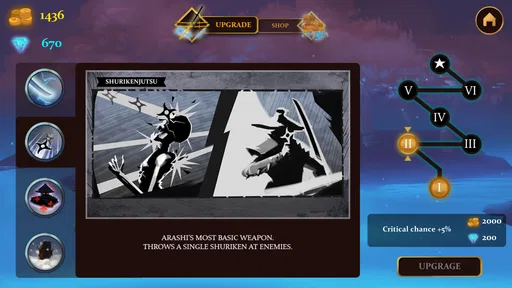
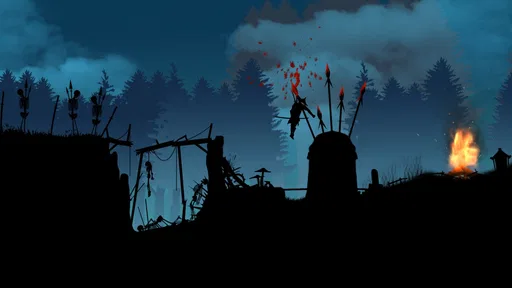
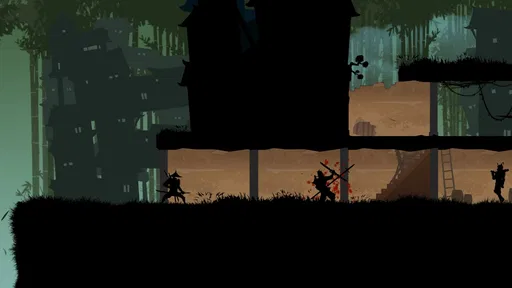
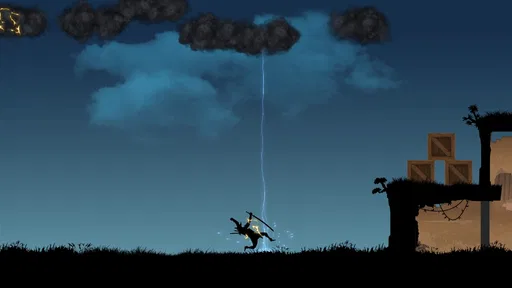
Our Review of Ninja Arashi
 Analysis by Appyee
Ninja Arashi is the kind of adventure game I open when I want a focused challenge rather than a long, story-heavy production. It combines fast platforming with an intense shadow-art presentation and light RPG elements, so its appeal comes from timing, movement, and gradual improvement. I found it easy to understand within minutes, but much harder to play consistently once the stages began demanding accurate jumps and careful reactions.
It is a free game from Black Panther, available for players who meet the Teen content rating, and it supports devices running Android 6.0 or later. The current version is 1.9.3. Its scale is also hard to ignore: the game has passed 100 million installs, with an average score of 4.6 from around 697,000 ratings and roughly 9,700 written reviews. Those figures do not replace personal experience, but they do suggest that its compact action-platforming formula has reached a very large audience.
Why the shadow-platforming style works
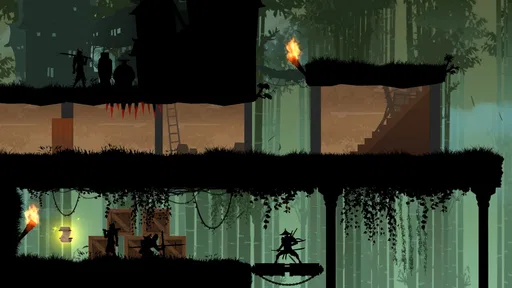
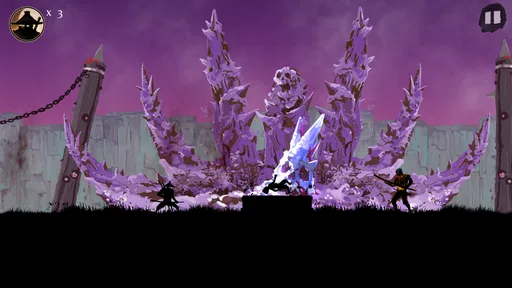
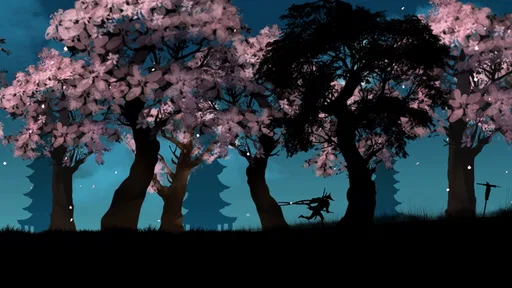
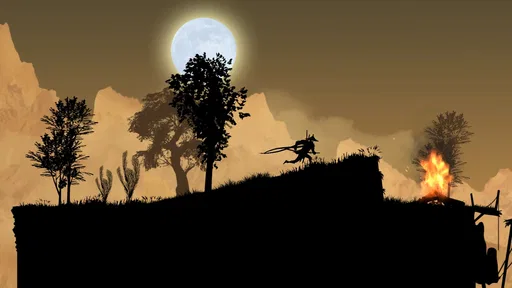
The first thing I noticed is how strongly the visual style supports the gameplay. The dark silhouettes, sharp outlines, and limited color palette make the ninja easy to identify against the background. That matters in a platformer because I need to read a jump, an obstacle, or an enemy quickly. The presentation is not merely decorative; it keeps the screen visually organized when several hazards appear close together.
The basic pleasure comes from moving through dangerous spaces while trying not to lose control. A jump that looks simple at first can require a precise approach, and a mistake often teaches me more than a successful run does. I began paying attention to where I stood before jumping, how much room I had to react, and whether rushing would leave me exposed to the next threat.
That learning curve gives the game a different mood from a relaxed adventure title. I would not describe it as something I play passively while watching a video. It asks for attention, especially when a sequence combines narrow platforms, enemies, and hazards. The controls are most satisfying when my failure feels like a timing problem I can correct rather than a random outcome.
The RPG influence adds another layer to this otherwise direct platforming structure. Instead of treating every stage as an isolated reflex test, the game gives progression a role in how the ninja develops. I liked that this creates a reason to return to earlier challenges and think about improvement beyond simply memorizing a route.
At the same time, players should not expect a deep role-playing system in the same sense as a large mobile adventure with extensive dialogue, equipment management, or character-building menus. The RPG elements support the action rather than replace it. If you mainly want exploration, a large world, and a long narrative, this is probably not the best match. If you prefer a compact loop of movement, danger, upgrades, and repetition, the blend is much more convincing.
Progress feels better when I treat failure as practice
My most useful change in approach was to stop judging a stage by whether I completed it on the first attempt. The game becomes less frustrating when I use early runs to identify the rhythm of a section. I look for the safe place before a jump, watch how an enemy occupies space, and remember which mistake ended the previous attempt. That turns repeated failure into a practical learning process.
A simple everyday scenario shows where it fits well. If I have a short break while waiting for an appointment or commuting, I can play a few focused attempts without needing to remember a complicated story. The same design can also work against it: if I am tired, distracted, or looking for something soothing, the demand for timing makes it easier to put the game down than to relax with it.
The best sessions are not necessarily the longest ones. After several failed attempts at the same section, I find that taking a brief pause helps more than forcing another run. Returning with a clearer head makes the controls feel more predictable. That is a small but important tip for this particular style of game: progress often comes from changing the quality of attention, not merely increasing playtime.
The progression also creates a trade-off around pressure. Improvement systems can make a difficult level feel more approachable, because I have something to work toward besides perfect execution. However, they can also tempt me to rely on development rather than learning the stage. When that happens, the most useful upgrade is often better route knowledge and timing. The game is strongest when progression complements skill instead of becoming a substitute for it.
Free access and the question of spending
The game is free to download, with in-app purchases listed at $0.99 to $1.99 per item. That gives players a low-risk way to try the core experience before deciding whether it deserves a place on their device. I appreciate that the entry point is simple: someone interested in shadow-style platforming does not need to commit money before discovering whether the controls suit them.
From a spending perspective, I would approach the purchase options cautiously and personally. A small item can seem harmless, but repeated purchases can change how I experience a progression-focused game. My preferred method is to play naturally first, understand where the real difficulty lies, and only then decide whether spending would improve my enjoyment rather than merely shorten the learning process.
The listed purchase range is clear, but the purchase context alone does not tell me how essential any item is during normal play. I would not assume that paying is required, nor would I promise that every player will find the free route equally comfortable. The sensible choice is to treat purchases as optional until the game itself demonstrates a reason to consider them.
That distinction matters for fairness. In a platformer, a victory feels most satisfying when I believe my movement and decisions produced it. If spending ever makes progress feel less earned, the value of the purchase becomes questionable for me. Players who enjoy mastering difficult sections should protect that sense of achievement by setting a personal spending limit before they start.
How fair does the challenge feel?
My view of the competitive side is slightly different from how I judge a multiplayer game. Ninja Arashi is primarily a personal challenge: I am competing against the level design, my own reactions, and my previous attempts. There is no reason for me to treat it like a contest where paid advantages would automatically put another player at a disadvantage.
That does not make fairness irrelevant. A single-player platformer still needs to make success feel connected to skill. The shadow visuals help because they make hazards and movement readable, while the RPG layer gives me another way to respond to difficulty. The balance feels most convincing when I can identify the cause of a failure and adjust my behavior on the next try.
For players who want a pure test of reflexes, the progression systems may feel like an interruption. A traditional arcade platformer can be preferable if the goal is to measure execution without character development. On the other hand, players who dislike repeating an exact challenge with no sense of growth may appreciate the way Ninja Arashi softens that rigidity through its adventure and RPG influences.
I also think the game suits people who enjoy deliberate improvement more than people who want instant mastery. The fair-minded way to play is to separate two questions: “Can I beat this section right now?” and “Do I understand what I need to improve?” The second question is more useful, especially when a stage exposes a weakness in jumping, positioning, or patience.
What I would want to know before installing
The Teen content rating is worth considering before handing the game to a younger player. It is not a detail I would ignore simply because the art uses silhouettes. Parents and players should check whether that rating fits their household expectations, particularly when the game is being installed on a shared device.
Device compatibility is relatively approachable for an older Android phone or tablet because the minimum operating system is Android 6.0. Still, operating-system support is not the same as a promise of identical performance on every device. I would keep expectations realistic on older hardware and make sure the game feels comfortable to control before investing significant time in progression.
Another practical question is whether this is a good replacement for a larger adventure game. In my opinion, it is not a substitute for an open-world experience, a narrative role-playing game, or a multiplayer title built around social competition. Its strength is narrower and clearer: it offers compact action-platforming with a dark visual identity and enough progression to make repeated attempts meaningful.
I would also ask whether the game is suitable for someone who dislikes repetition. The answer is probably no. Replaying difficult sections is part of the experience, not an occasional inconvenience. If a failed attempt feels unacceptable, the game may become stressful quickly. If repeating a section to understand its timing feels rewarding, the same design can become its main attraction.
One useful workflow is to play with a short objective rather than an undefined promise to “make progress.” I might focus on learning one hazard sequence, testing one movement pattern, or reaching one new checkpoint in a session. This keeps the pressure manageable and makes the RPG progression feel connected to actual improvement instead of turning every session into a demand to finish more content.
Where it fits among mobile adventure games
Compared with story-led mobile adventures, this game is more immediate and mechanically demanding. I spend less time waiting for dialogue or managing a broad map and more time reading the next few seconds of movement. That makes it a better choice for players who want interaction from the first moment of a session.
Compared with endless runners, it offers a more intentional sense of place and progression. An endless runner often emphasizes quick reactions across a continuously moving route, while this experience rewards studying a section and improving a response. The difference is important: I feel more responsible for planning a jump here than I do when reacting to an automatically advancing track.
Compared with a pure arcade platformer, the RPG elements make the experience less severe for some players and less pure for others. The additional progression can give a difficult adventure more persistence, but it can also make the design feel less like a fixed test of ability. I would choose this game when I want challenge with a sense of development, not when I want the cleanest possible competitive benchmark.
The visual identity is another reason to choose it over a conventional cartoon platformer. The shadow-art approach gives the game a serious, dramatic mood without requiring a large amount of visual clutter. Players who prefer bright, playful worlds may find it too somber, while anyone drawn to silhouettes and ninja imagery will understand its appeal quickly.
Who should play, and who should skip it
I recommend it to players who enjoy timing-based movement, repeated attempts, and games that can be understood quickly but mastered gradually. It is also a good fit for someone who wants an adventure game that works in short sessions and does not depend on a large social community to feel worthwhile.
I would be more hesitant to recommend it to a player looking for a gentle relaxation game. The challenge can demand concentration, and the satisfaction comes from overcoming resistance rather than drifting through a calm environment. I would also steer away anyone who wants a highly detailed role-playing system, a broad exploration map, or a multiplayer competition with visible opponents.
Players concerned about spending can begin with the free version and create a simple rule: no purchase until the basic loop has proved enjoyable without it. Because individual items are listed between $0.99 and $1.99, the prices are easy to understand, but the more important question is whether an item supports enjoyment or merely reduces the satisfaction of learning. That is a decision I would make only after experiencing the game’s normal progression.
My trust verdict after weighing the trade-offs
After balancing the strong visual direction, focused platforming, RPG-flavored progression, and the pressure created by repeated failure, I see Ninja Arashi as a specific recommendation rather than a universal one. It succeeds because it knows what kind of game it wants to be: a dark, compact adventure built around movement and persistence. It does not need a huge feature list to justify its appeal.
The free price makes trying it straightforward, while the Teen rating, Android 6.0 minimum, current version 1.9.3, and optional purchases give potential players useful practical context before installation. Black Panther has built a game that is easy to sample but more demanding to stay with. Its popularity is substantial, yet the right question is still whether you enjoy learning through failure.
My honest recommendation is to install it if you want a challenging shadow-style platformer and are comfortable treating progress as practice. Start without spending, play in focused sessions, and judge purchases by whether they add enjoyment rather than simply remove obstacles. If you want a story-first adventure or a completely relaxed experience, choose something else. For everyone who likes precise movement, dark presentation, and the small satisfaction of finally clearing a section that defeated them earlier, this is a worthwhile free game to try.
Verdict
Strengths of Ninja Arashi
- Fast-paced platforming with responsive controls.
- Stylish shadow-themed visuals create a distinctive atmosphere.
- Challenging traps and enemies keep each level engaging.
- Multiple abilities add variety to combat and exploration.
- Offline play makes it convenient for gaming anywhere.
Limitations of Ninja Arashi
- Some difficulty spikes may feel frustrating for casual players.
- The story is brief and mainly serves as a simple backdrop.
- Repeated enemy patterns can become predictable over time.
- Ads may interrupt the experience in the free version.
- Limited character customization reduces long-term personalization.
Other Releases by Black Panther
View All
Ninja Arashi 2
Adventure4.5

Ninja Arashi 2 Shadow's Return
Adventure4.4
Similar Picks in This Category
View All
Roblox
Roblox Corporation4.2

Pokémon GO
Niantic, Inc.3.5

Ninja warrior: legend of adven
TOH Games4.6

Eyes - The Horror Game
Fearless Games sp. j.4.5

Critical Action:Gun Strike Ops
FPS Shooter & Action Game4.3

Car Parking Games - Car Games
Frolics Simulation & Action Games4.3
Frequently Asked Questions
What is Ninja Arashi, and what kind of game is it?
Ninja Arashi is a 2D action-platformer for Android and iOS that combines fast movement, traps, enemies, exploration, and light role-playing elements. You play as Arashi, a skilled ninja trying to rescue his kidnapped son from the demon Orochi. The game focuses on precise jumps, sword attacks, wall movement, and learning enemy patterns across dark, atmospheric stages.
Is Ninja Arashi free to download and play?
Ninja Arashi is generally available as a free download, allowing players to experience its main platforming adventure without paying upfront. However, the game may include advertisements, optional purchases, or paid content depending on the version and device platform. It is recommended to check the store listing before downloading, especially if you want to understand the current advertising and in-app purchase conditions.
Does Ninja Arashi require an internet connection?
Ninja Arashi is primarily designed as a single-player experience, so most of the core gameplay can usually be enjoyed without a constant internet connection. You can progress through levels, fight enemies, and explore areas offline. An internet connection may still be needed for downloading the game, receiving updates, displaying certain advertisements, restoring purchases, or accessing any online features included in your version.
Is Ninja Arashi suitable for beginners and younger players?
Ninja Arashi is easy to understand because its controls are straightforward, but the game becomes challenging as traps, enemies, and level layouts become more demanding. It is a good choice for players who enjoy patience-based platforming rather than completely casual gameplay. The dark story, combat, and occasional difficulty may be better suited to older children, teenagers, and adults than very young players.
What are the main advantages and disadvantages of Ninja Arashi?
The main advantages of Ninja Arashi include its stylish shadow-based visual design, atmospheric soundtrack, responsive controls, varied traps, and satisfying progression. The game also works well for short play sessions while offering enough challenge to encourage repeated attempts. On the other hand, some players may find the difficulty frustrating, encounter repetitive combat, or dislike advertisements and optional purchases that can affect the overall experience.
Play our best games!


